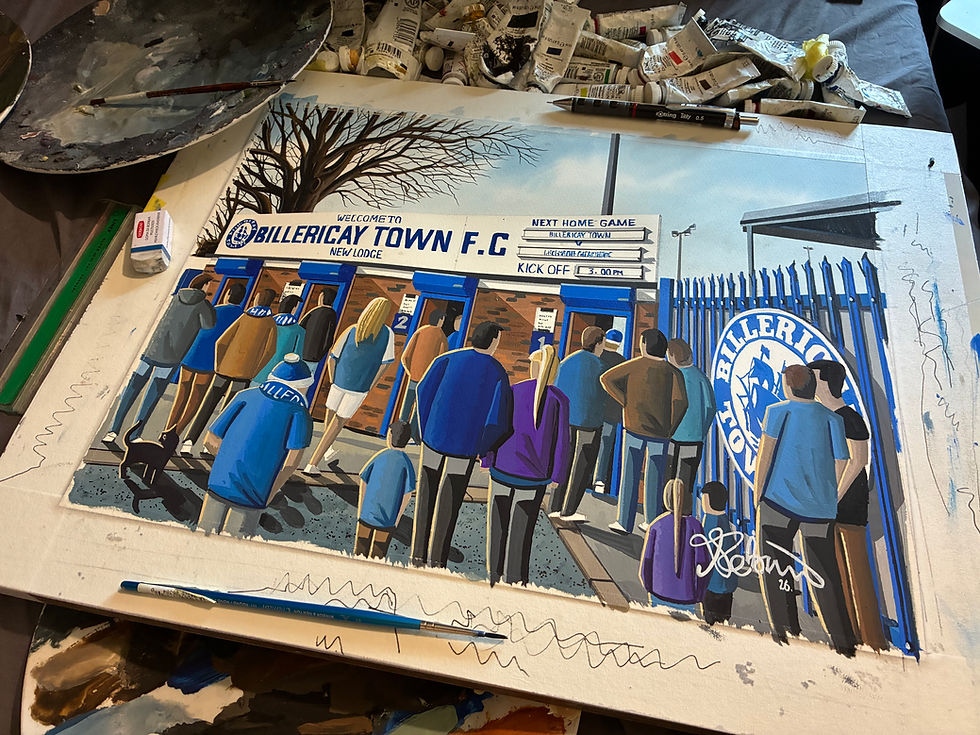
The Black Cat Maker Mark in Every Painting

At some point, someone spots him.
A small black cat tucked into a corner. A curved tail half-hidden in shadow. A pair of pointed ears sitting quietly beside a chair leg, a wall, a window, or the edge of a path. Once noticed, he raises the same question again and again: why is there a black cat in every painting?
The answer begins long before my own work. It belongs to a much older story about artists, craft, identity, and the quiet marks makers leave behind.
For thousands of years, craftspeople and artisans have added maker’s marks to their finished work. These marks might be simple, complex, decorative, practical, obvious, or almost invisible. They help identify who made a piece, where it came from, and sometimes how it was made.
In my paintings, that role belongs to the black cat.

Maker’s marks have a very long history
A maker’s mark is one of the oldest ways an artist or craftsperson can say, “I made this.”
Long before modern labels, certificates, catalogues, galleries, and digital archives, makers still needed a way to identify their work. A mark could link an object to a person, a workshop, a place, or a tradition. It could act as a sign of skill, ownership, quality, and trust.
Some of the earliest known examples appear on ancient Greek pottery. Potters and painters sometimes marked vessels with names, symbols, or inscriptions. These marks were not modern trademarks in the legal sense, but they served a similar human purpose. They connected an object to its maker.
That idea travelled through many crafts.
You can find variations of maker’s marks in:
Jewellery, where tiny stamped symbols can identify a maker or workshop.
Metalwork, where hallmarks and workshop marks help show origin and authenticity.
Stone carving, where masons left marks on blocks and buildings.
Woodwork, where cabinetmakers, carvers, and instrument makers marked their pieces.
Ceramics, where potters used stamps, initials, painted marks, or impressed signs.
Fine art, where signatures, monograms, symbols, and recurring motifs became part of an artist’s identity.
These marks are often modest. Some sit underneath a pot, inside a joint, behind a frame, or near the base of a carved stone. The maker may not shout. They simply leave a trace.
That trace matters.
It tells later viewers that a real person stood behind the work. Someone chose the material, shaped the form, made decisions, solved problems, and finished the piece by hand. A maker’s mark turns an object into a record of human presence.

A maker’s mark can reveal more than a name
At first glance, a maker’s mark may look like a signature. Sometimes it is. Yet the best marks often carry more meaning than a written name alone.
A mark can reveal the who, what, when, where, and how of a finished piece.
The “who” may be the individual artist, craftsperson, or workshop. The “what” may relate to the type of object, process, or tradition. The “when” might be learned through a style of mark used during a certain period. The “where” can point to a region, kiln, guild, foundry, or studio. The “how” may be visible in the way the mark was stamped, carved, painted, engraved, or impressed.
That is why maker’s marks are useful to collectors, historians, restorers, and anyone who cares about provenance. They help protect authenticity. They can support attribution. They can separate an original from an imitation, or a handmade piece from a mass-produced copy.
They also give the maker a continuing voice.
A painting can leave the studio and travel into another home, another room, another life. The mark travels with it. It says that the work has an origin. It has a maker. It has not simply appeared.
The Black cat makers mark in my paintings belongs to that tradition. It acts as a personal signature, but also as a small piece of visual folklore within the work.

Why mine is a black cat
Every maker’s mark needs a form. Mine became a black cat.
The black cat is small enough to hide, clear enough to recognise, and flexible enough to live naturally inside different paintings. He can curl into a shadow, sit upright near a doorway, stretch along a line, or appear almost as a passing thought. He does not need to interrupt the painting. He belongs inside it.
That matters to me.
I did not want a mark that felt pasted on after the fact. I wanted something that could be woven into the scene and still remain recognisable. The cat can change pose, size, and level of visibility while keeping his identity. He has become part of the language of the work.
Sometimes he is easy to find. Sometimes he is nearly hidden. He may be bold and graphic in one painting, then softened into the surrounding tones in another. He might sit in the foreground, but he might also disappear into a dark shape, a patterned area, or the edge of the composition.
That shifting presence keeps him alive.
A written signature tends to stay still. A cat can move.
He also carries associations that suit the paintings. Cats are watchful. They are independent. They slip through spaces without asking for attention. A black cat, especially, has a long history in folklore and imagination. Depending on where and when you look, it may be seen as lucky, unlucky, mysterious, protective, mischievous, or wise.
I like that tension. The cat can be playful, but he is not only a joke. He is a guardian of authenticity. He is a quiet witness. He is a mark of authorship that asks the viewer to look again.
The short version is this: the black cat, sometimes affectionately called the Puppo Cat in the studio, works as a trademark for andrewrobinsonart, He appears in the andrewrobinsonart registered trademark and also within the painting as a trademar. He's a way for Andrew Robinson to invite people to find hidden authenticity in the work of artists and craftspersons.
The mark changes from painting to painting
A maker’s mark does not have to be identical every time to be meaningful.
Many historic marks vary. A stamp may wear down. A hand-painted symbol may shift slightly. A carved mason’s mark may look different depending on the stone, tool, scale, or working position. Even a signature changes with age, mood, speed, and material.
The black cat follows that same living pattern.
He is not always the same size. He is not always in the same pose. He does not always sit in the same part of the painting. Sometimes he is clear and crisp. Sometimes he is partly covered by texture, colour, or shadow. At times, he becomes part of the composition before he becomes a mark.
That variation is intentional.
If the cat were always placed in the same corner at the same size, he would become predictable. He would feel separate from the painting, more like a label than a living element. By changing his position and pose, I can let him respond to the image itself.
In one painting, he may balance a strong vertical line. In another, he may soften a dark area. In another, he may act as a small pause for the eye. The mark remains consistent in meaning, but flexible in use.
That balance is what makes it enjoyable.
The cat identifies the work, but he also invites discovery. He gives the viewer a small reason to slow down. Looking for him becomes part of looking at the painting.

Why hidden marks make people look more closely
A hidden maker’s mark changes the relationship between the viewer and the work.
A painting can be taken in quickly. Colour, subject, composition, mood, and scale often arrive first. Then the details begin to appear. The longer someone looks, the more the painting opens up.
The black cat encourages that second stage of looking.
Once people know he is there, they search. They scan the corners. They study the shadows. They look at shapes they might otherwise pass over. They notice small decisions in the painting because they are hunting for one particular clue.
This is not a gimmick. It is a way of rewarding attention.
Art has always contained hidden layers. Renaissance painters placed symbols in flowers, animals, gestures, fabrics, and light. Medieval masons carved strange faces into churches. Printmakers hid initials in textures. Contemporary artists often use repeated signs, private references, or coded motifs.
A hidden mark can be intimate. It creates a small exchange between maker and viewer.
The artist says, “Look carefully.”
The viewer replies by staying with the work a little longer.
That extra time matters. It changes the experience from passive viewing to active seeing. The painting becomes a place to explore, not just an image to glance at.

Authenticity is more than a certificate
A certificate of authenticity can be useful. So can records, photographs, invoices, gallery histories, and catalogues. Yet authenticity also lives within the object itself.
The surface of a painting carries evidence of its making. Brushstrokes, colour choices, underpainting, texture, corrections, edges, and marks all form part of its identity. A maker’s mark belongs to that evidence.
The black cat does not replace a signature or written record. It adds another layer.
He is there in the painted world itself. He is not an afterthought on the back of the frame or a line on a document. He belongs to the front of the work, even when hidden. That gives him a special role.
He says, quietly, that the painting came from a particular hand and imagination.
For collectors, marks like this can become part of the pleasure of ownership. For returning viewers, they create continuity across different pieces. For me, the cat keeps each painting connected to a wider body of work while still allowing every piece to stand on its own.
That is one of the strengths of a good maker’s mark. It can be personal and practical at the same time.

How to find the black cat
There is no single place to look, but there are a few useful habits.
Start with the edges. The cat often enjoys the margins of a painting. Look near doorways, windows, skirting lines, paths, chairs, trees, walls, and darker shapes.
Then look for his outline. You may spot:
A curved tail
Two pointed ears
A small seated body
A dark shape that feels just a little too deliberate
A pair of eyes or a simple silhouette
Do not only search the shadows. Sometimes he is clearly visible. Sometimes he sits in plain sight and still goes unnoticed because the larger painting pulls attention elsewhere.
Most of all, take your time.
A hidden mark is not meant to be found in a rush. It asks for the same thing the painting asks for: careful looking.

A small mark with a long memory
The black cat in my paintings is playful, but he carries a serious idea.
He belongs to a tradition that reaches back through centuries of making. Potters, jewellers, metalworkers, stonemasons, woodworkers, painters, and many others have all found ways to leave their identifying marks on finished work. Those marks protect authenticity, connect objects to their makers, and give future viewers a path back to the hand that made them.
My black cat does the same in his own small way.
He may be sitting proudly in the open. He may be tucked into a shadow. He may be stretched, curled, hidden, or only partly visible. But he is always there.
So the next time you look at one of my paintings, do not stop at the first impression. Let your eye wander. Check the corners. Follow the dark shapes. Look twice at anything that seems to be quietly watching you.
Find him if you can.