


Returning to Painting New Lodge and Finding My Rhythm Again

The hardest part of returning to painting is not always the painting itself. Sometimes it is getting back into the quiet routine around it: clearing the table, choosing the subject, mixing the first wash, and trusting that your hand still remembers what to do.
After a break, that first session can feel oddly loaded. You want the work to feel fresh, but you also want to prove to yourself that the rhythm has not gone completely missing. That was very much the mood behind my latest piece, an interpretation of New Lodge, home of Billericay Town F.C.
It felt like the right subject to come back with. A proper non-league ground. A club with history. A place with enough structure, charm, and character to make it interesting on paper without becoming too fussy. More than anything, it gave me a reason to stop tinkering with the shop for a bit and actually paint again.
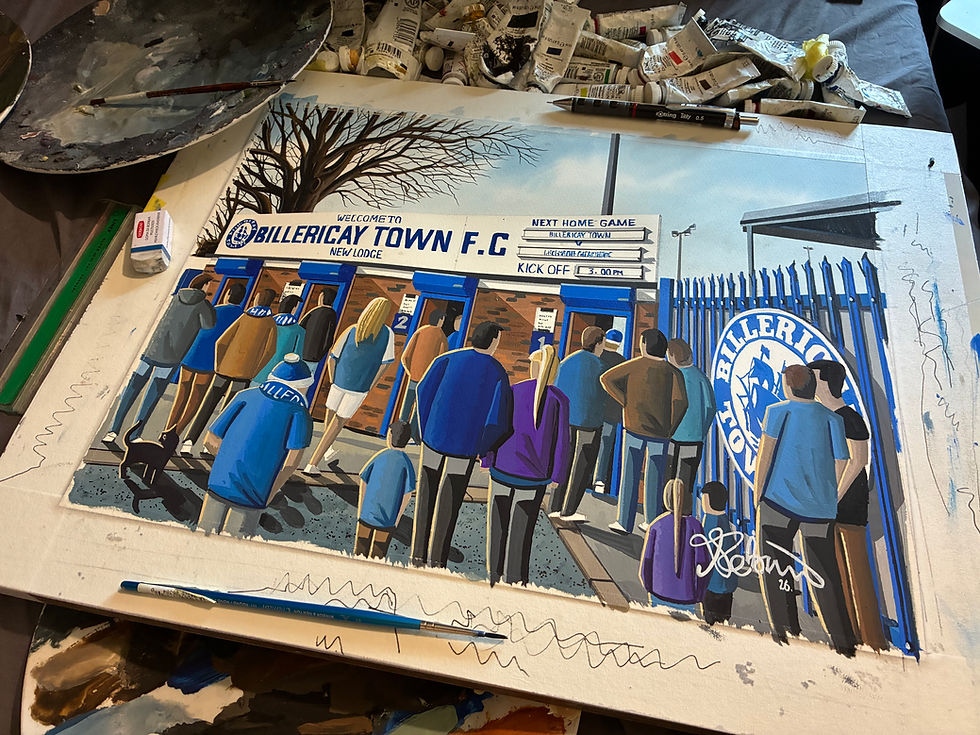
Coming back to the desk after a break
There is a strange pressure that builds when you have not painted for a while. I do not mean dramatic, tortured-artist pressure. I mean the everyday kind.
You walk past the paints and think, “I should really get back to that.” Then an order comes in. Then a product listing needs fixing. Then a variation on the shop has gone odd. Then you realise the day has disappeared into packaging, admin, and tiny decisions that somehow take longer than painting a stand roof.
That has been the balance recently. I love making the artwork, but the online shop has its own demands. Prints need to be listed clearly. Sizes need to make sense. Framed and unframed options need checking. Product variations need to behave properly, which sounds simple until one small setting creates three more things to sort out.
The funny thing is that the shop exists because of the paintings, but it can easily start eating into the time meant for painting. If you sell creative work online, you will know the feeling. The creative part is the heart of it, but the practical part keeps the doors open.
So returning to New Lodge was also a small reset. I wanted to sit with one subject and give it proper attention again. Not rush it. Not treat it like a product file waiting to be uploaded. Just paint the ground, make decisions, and enjoy the process.
Why New Lodge made sense as the subject
New Lodge has the sort of presence I enjoy painting. It is not about gloss or spectacle. It is about place.
Football grounds, especially non-league grounds, carry details that feel lived in. Stands sit close to the pitch. Fencing, rooflines, floodlights, signage, hard standing, and patches of open space all add to the character. A ground like New Lodge gives you plenty to work with, but it also asks you to choose what matters.
For this piece, I did not want to create a rigid architectural study. I wanted an interpretation, something that felt recognisable but still had the looseness of gouache and watercolour. The aim was to capture the feel of the ground rather than every bolt and panel.
That is where painting football stadiums becomes interesting. You are always balancing accuracy with atmosphere. Too much detail and the picture can become stiff. Too little and you lose the identity of the place. The sweet spot sits somewhere between the two.
For New Lodge, I found myself drawn to the strong horizontal shapes, the pitch-side structures, and the way the ground sits as a familiar local landmark rather than a grand arena. That suits my work. I like grounds that feel connected to the people who use them.
A brief nod to Billericay Town F.C. history
Billericay Town F.C. has a long history behind it. The club was established in 1880, which gives it roots stretching through well over a century of local football.
That kind of age matters when you are painting a club’s home. You are not just painting a building or a set of stands. You are painting a place that has held generations of Saturday afternoons, cup runs, volunteers, supporters, players, and all the small rituals that come with following a team.
The club is especially well known for its success in the FA Vase. Billericay Town won the competition three times in the 1970s, with victories in 1976, 1977, and 1979. That era remains a major part of the club’s story and gives Billericay a strong place in non-league football history.
I always enjoy when a ground comes with that sort of background. It adds weight to the painting without needing to spell everything out visually. A viewer might simply see New Lodge. A supporter will see much more: old results, familiar routes to the ground, the sound of a match day, and perhaps a few memories that have nothing to do with the final score.
That is one reason I keep coming back to football grounds as subjects. They are full of quiet meaning. Even a simple stand or terrace can carry a lot of memory.

Working with a limited palette
A limited palette helps the whole painting feel more coherent. When the same colours echo across the sky, stands, shadows, and pitch, the image holds together. Nothing feels pasted on. Even small accents feel like they belong because they come from the same family of mixes.
For New Lodge, I leaned into muted, natural tones. The sort of colours that suit a British football ground in changing light:
soft blues and greys for the sky and shadow
Browns that feel grounded rather than bright
warm neutral tones to keep the structures from looking cold
darker mixes for definition around roofs, rails, and edges
The key is not to make everything dull. It is to give the brighter notes somewhere to sit. If every colour shouts, the painting becomes noisy. If most colours speak quietly, the important parts can come forward.
That matters with stadium artwork. There are already a lot of shapes competing for attention. Barriers, rooflines, floodlights, seats, signage, fencing, and the supporters can all pull the eye in different directions. A limited palette helps calm that down.
It also creates a stronger identity for the finished piece. The painting feels like one complete thought rather than a collection of separate details.

Finding the pace again
The early stages of a painting are always a bit fragile. You are making decisions that will affect the whole piece, but it still looks like very little. After time away, that stage can feel even more uncertain.
I had to remind myself not to judge the work too early. A first wash rarely looks like the final piece. A loose block-in can feel underwhelming. A stand might look too heavy until the pitch goes in. A sky might feel flat until the darker lines arrive.
That is where rhythm comes back. Not all at once, but through repetition.
Mix a wash. Let it dry. Strengthen an edge. Step back. Soften a shape. Leave something alone. Make a mark and resist the urge to fiddle with it.
Painting is full of these tiny negotiations. The more you do them, the more natural they feel. After a break, you can still do them, but you may need to move a little slower until your confidence catches up.
I found that with New Lodge. Once the first few layers were down, I started to relax. The painting became less about “getting back to work” and more about responding to what was in front of me. That is usually when the best decisions happen.
The eye issue that slowed things down
I also need to mention something that has affected my painting schedule: I have been dealing with an eye issue.
I am not going to go into the full story here, partly because it deserves its own post and partly because I want to explain it properly rather than squeeze it into the middle of a painting update. It has made close work more difficult at times and has definitely changed how I plan my sessions.
Painting asks a lot from your eyes. You are judging edges, colour shifts, tiny shapes, and small changes in tone. Even when a piece looks loose, there is a lot of looking involved. When your eyes are not playing along, the whole process slows down.
That has meant shorter painting sessions, more breaks, and a bit more patience than I naturally have. It has also made me think harder about how I work. Good light matters. Rest matters. Knowing when to stop matters too.
I will write more about the eye issue in a future post, especially how it has affected the practical side of painting and running the shop. For now, it is enough to say that it has been one of the reasons my painting rhythm has taken longer to return.

Balancing the artwork with the online shop
The other big challenge has been the shop itself. I am grateful for it, and I enjoy sending work out into the world, but there is a lot going on behind the scenes.
A single artwork can become several product options. There may be different print sizes, paper choices, framed options, and gift-friendly versions. Each variation needs clear wording and the right settings. If one thing is unclear, it can cause confusion later.
That is especially true with football artwork, because people often buy prints as presents. Birthdays, Christmas, Father’s Day, leaving gifts, thank-you presents, and personal keepsakes all come into it. Supporters want the ground to feel right. They want the club connection to be clear. They want to know what they are getting.
So while the painting is the visible part, the shop work shapes how people find and choose it. That includes writing descriptions, checking images, making sure framed options are easy to understand, and keeping the whole thing tidy enough that buying a print feels simple.
Some days, the admin wins. Other days, the painting wins. The trick is accepting that both are part of the same job.
I have also been thinking about how people search for this kind of work. Phrases can get oddly long, but they reveal what someone is hoping to find. Something like billericay town FC football art prints framed art artwork hand painted stadiums gifts presents christmas birthdays gouache watercolour sounds like a mouthful, yet it captures the mix of club, medium, format, and occasion that often brings someone to a piece like this.
That is the strange meeting point between art and online selling. One side is quiet and visual. The other side needs words, categories, and options. Both matter.
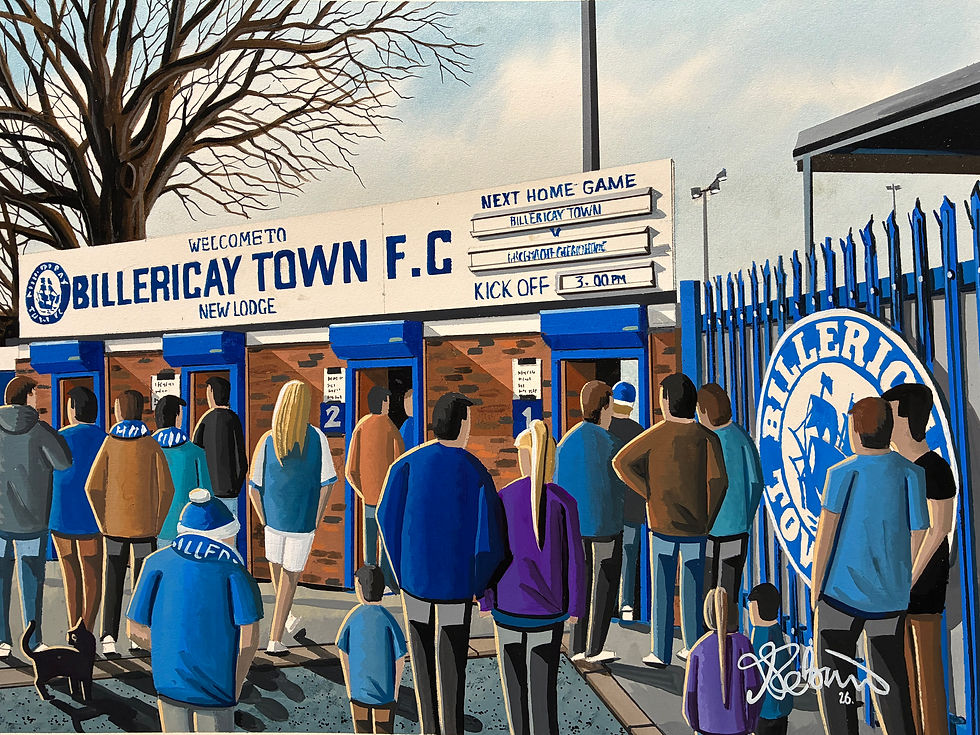
What this New Lodge piece taught me
This painting reminded me that returning does not have to be dramatic. You do not need a grand plan. You need one subject that interests you and enough time to begin.
New Lodge gave me that. It had structure without feeling sterile. It had history without needing to be overexplained. It gave me space to use a limited palette and rebuild my confidence one layer at a time.
It also reminded me why I enjoy making hand painted football prints in the first place. Football grounds are personal. They mean different things to different people. One person sees a stand. Another sees their first match. Someone else sees a relative they used to go with, a season they will never forget, or a club that has been part of their life for years.
That emotional weight is easy to miss if you only look at the architecture. The painting has to leave room for memory.
I do not know if every piece teaches you something new, but this one certainly reminded me of a few things I had half-forgotten:
Simple colour choices can make a painting stronger.
Breaks do not erase your ability.
Admin is part of the job, but it cannot be allowed to take all the space.
Health issues change the pace, and that is frustrating, but workable.
A football ground does not need to be huge to be full of meaning.
Back in motion, one painting at a time
I am glad New Lodge became the piece that brought me back to the paints. It was a manageable subject, but not a bland one. It gave me enough challenge to get absorbed again, and enough familiarity to keep me grounded.
There is still a balance to find. The shop will always need attention. Product variations will still find ways to be more awkward than they should be. My eye issue still needs care, and I will share more about that soon.
But the main thing is that I am painting again.
That feels like progress. Not a dramatic restart. Not a complete overhaul. Just a return to the brushes, a limited palette, a ground with history, and the quiet satisfaction of seeing a new piece begin to come together.
The rhythm is not fully back overnight, but it is returning. For now, that is enough.


