


The Oldest Fish and Chip Shop in the World. Art Prints of a Nostalgic Night Scene and Memories of a British Institution

Some places become part of the way a town remembers itself. Not because they are grand, or polished, or famous in the usual sense, but because they sit there through ordinary days, feeding people, warming hands, and giving off that unmistakable smell of vinegar, hot fat, and paper-wrapped chips.
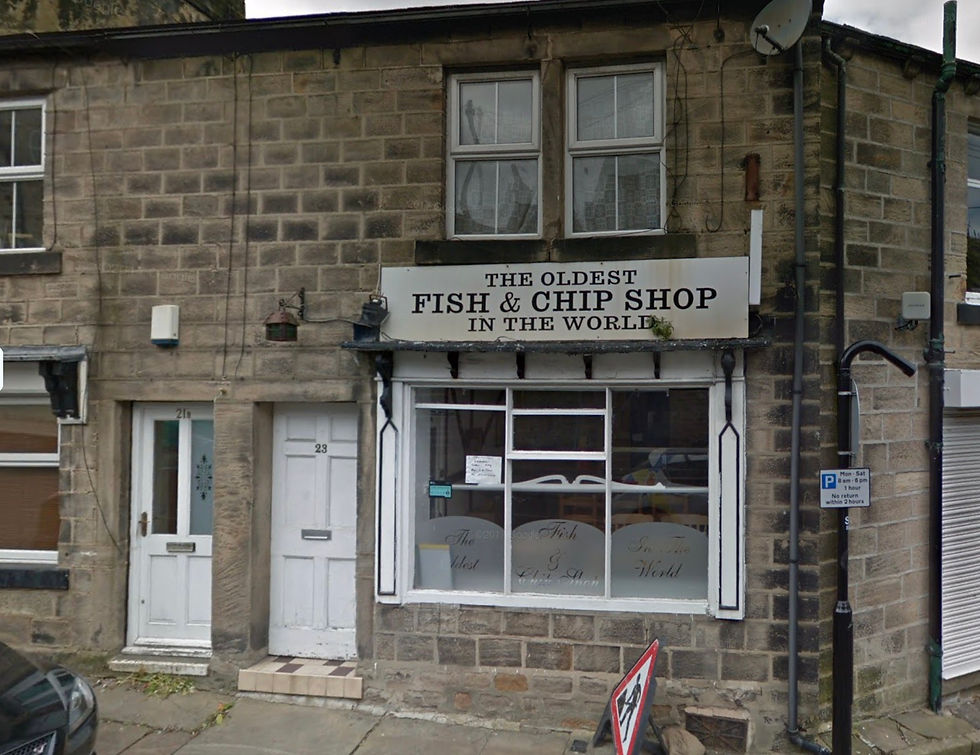
The old fish and chip shop in Yeadon, near Leeds, was one of those places.
Widely known as the world’s oldest fish and chip shop, it carried a kind of quiet weight. It was never just a chippy. It was a marker in the street, a meeting point, a local story, and a small piece of British food history. Its closure felt like more than the shutting of a door. For many people, it felt like the loss of a familiar light.
Painting it as a night scene became my way of holding onto that feeling. Not as a perfect record, but as a memory. The sort of memory that gets brighter once the real place begins to disappear.
Why the Yeadon fish and chip shop mattered
Fish and chips has always had a special place in Britain. It is food with its sleeves rolled up. It belongs to Fridays after school, seaside holidays, factory teas, football nights, and the walk home when it is too cold to cook. I thought It would Make an ideal nostalgic art print.
The Yeadon shop stood for that tradition in a very direct way. Its claim as the world’s oldest fish and chip shop linked it back to the Victorian roots of one of Britain’s best-loved meals. Long before chain restaurants and delivery apps, shops like this served local communities with something simple, filling, and affordable.
That is part of the charm. A fish and chip shop does not need to be rarefied to be important. Its value lies in repetition.
People remember:
The same counter they stood at as children
The same smell drifting down the street
The same order called out by the fryer
The same paper parcel carried home under one arm
The same first chip, eaten too hot, with too much vinegar
The Yeadon shop held all of that, and it held it across generations. Parents took children there. Those children grew up and came back. Some moved away and still remembered it as part of home.
That is why closure cuts deep. When a place like this closes, it is not just a business story. It is a local culture story.

The sadness of a shuttered British institution
When news spreads that an old shop has closed, people react in a way that is often deeply personal. They remember the owner behind the counter. They remember going in after school. They remember waiting in the cold, watching steam fog the windows. They remember grandparents, old routines, small treats.
The closure of the Yeadon fish and chip shop brought out that kind of reaction. There was sadness, of course, but also gratitude. People shared memories because that is what communities do when a familiar place vanishes. They turn it into stories.
A shopfront can seem small until it goes dark.
Then you notice how much it anchored the street. You notice the missing glow. You notice the gap between what a building is and what a building meant.
There is also a wider feeling here. Across the UK, many long-running independent shops face pressure from rising costs, changing habits, and quieter high streets. Chippies, pie shops, cafés, bakeries, cobblers, hardware shops, all these places carry local character. They are not polished heritage attractions. They are working places, which is exactly why they matter.
The loss feels sharper because these places were never pretending to be special. They simply were.
That is the feeling I wanted to catch in the painting.

Turning a daytime reference into a nostalgic night scene art print
The painting did not begin as a night image. Like many of my pieces, it started with daytime reference material. Daylight gives you the facts. You can see the brickwork, windows, signs, roofline, pavement, and the general shape of the building.
But daylight does not always give you the feeling.
For this piece, I wanted the shop to feel remembered rather than simply observed. A night scene allowed that. It let the building hold warmth against the cold. It let the windows glow. It let the pavement reflect light. It let the street become quiet around the subject.
That shift from day to night is one of the most enjoyable and difficult parts of the painting process.
You have to make decisions rather than copy what is there. Where does the light come from? How far does it spill onto the pavement? Which details disappear into shadow? Which edges need to stay sharp? How much blue should sit in the dark sky before it becomes too theatrical?
In gouache, those choices feel very physical. The paint can be flat and graphic, but it can also carry little scuffed textures that suit old brick, damp stone, and painted signage. I like that balance. Gouache lets a shopfront feel designed and handmade at the same time.
This is where Painting Hertitage & culture becomes personal. The work is not only about recording a location. It is about asking what the place felt like, and how to translate that into colour, light, and shape.

The cold winter night outside the chippy
There is a particular kind of British winter night that suits a fish and chip shop better than anywhere else.
The air pinches your face. The pavement shines with old rain. Car tyres hiss along the road. Your hands are deep in your pockets, and your shoulders are slightly hunched against the cold. Then, just ahead, there is that rectangle of light.
Inside, everything changes.
The first thing is the warmth. It comes in a wave as the door opens. Then the smell follows, rich and familiar. Hot oil, potato, batter, salt, vinegar, maybe curry sauce, maybe mushy peas. It is not subtle, and it should not be. It is the smell of comfort arriving quickly.
There is sound too. The fryer bubbles and spits. Metal baskets clatter. Paper rustles. Someone asks for scraps. Someone else changes their mind at the last second and adds a fishcake. The till opens. The door goes again, and a gust of cold air slips in behind the next person.
The visual details matter because they are part of the memory. The glow of the menu board. The white tiles. The stainless steel. The condensation at the window. The pile of wrapped parcels waiting to be collected. The vinegar bottle lifted with practised confidence.
Then comes the walk home.
The chips are too hot to eat properly, so you try one anyway. The steam rises from the paper. Salt sticks to your fingers. The vinegar catches in the back of your throat. For a few minutes, the night feels softer.
That is the sensory world I wanted in the painting. Not just the building, but the feeling of standing near it. The promise of warmth. The little ritual of ordering. The way a chippy can brighten a dark street.

Painting memory without over-polishing it
When painting a subject like this, there is a temptation to make it too neat. Heritage can easily become polished until it loses its truth. But fish and chip shops are not meant to look pristine. Their beauty often comes from use.
A slightly worn sign can be more moving than a perfect one. Uneven brickwork carries age. A dark doorway can make the lit windows feel brighter. The odd mark and wobble in the paint can suggest a real street better than a perfectly ruled line.
I wanted the Yeadon painting to feel loved, but not sentimental in a false way.
That meant keeping some grit in the scene. The winter dark. The wet ground. The sense that the viewer is outside, looking in. There is warmth there, but also absence. The shop is both alive in memory and touched by closure.
That balance felt right.
It also reflects what many people feel about places like this. We miss them because they were ordinary. We miss them because we did not always know we were meant to treasure them. A chippy can be part of your week for years, then suddenly become part of your past.
The painting sits among my interest in fish and chips, fish & chips, British institutions, handpainted gouache, Andrew Robinson art, artwork prints, Yeadon, Leeds, England and the wider UK. Those words sound like search terms when lined up together, but behind them is something simple: a wish to notice the places that shaped everyday life.
Why British institution shops make such rich subjects
The Yeadon shop has made me think more about other British institution shops I would like to paint.
A London pie and mash shop is high on the list. Those places have such a strong visual language. Tiled walls, wooden benches, green liquor, proper plates, and a feeling that time moves differently once you step inside. They belong to London in a way that feels local and historic at once.
A Melton Mowbray pie shop is another idea I keep returning to. The pork pie has its own deep connection to place, craft, and regional pride. It would make a very different painting from a chippy, but the feeling would come from the same source. A shopfront, a food tradition, and a community that knows why it matters.
There are so many possibilities:
A seaside rock shop with faded awnings
A corner bakery before opening time
An old sweet shop with jars in the window
A market butcher under winter light
A tea room with steamed-up glass
A cobbler or hardware shop that seems to have survived every high street change
These places are not only visually interesting. They are emotional shortcuts. One glimpse of a sign, a counter, or a tiled wall can bring back a whole chapter of life.
That is why I keep coming back to them as subjects. They carry humour, warmth, regional identity, and memory. They ask to be painted with care.

What we keep when places close
A closed shop does not have to vanish completely. Buildings change, businesses move on, and streets keep shifting, but memory has its own stubborn life.
Art can help with that. So can photographs, conversations, local history groups, family stories, and the simple act of saying, “Do you remember that place?”
The Yeadon fish and chip shop matters because people do remember. They remember it as part of Leeds, part of Yorkshire, and part of the wider story of British food. They remember it as somewhere ordinary, useful, and loved.
For me, painting it at night made that memory feel clearer. The darkness gave the shop a stage, and the light gave it back its presence.
A fish and chip shop on a winter evening is one of those scenes that almost everyone in Britain can understand. You do not need a grand explanation. You can smell it. You can hear it. You can feel the paper warming your hands.
If this painting brings one of those memories back, then it has done what I hoped it would do.
Maybe it reminds you of Yeadon. Maybe it reminds you of a chippy near your school, or one by the sea, or one your grandparents swore was the best in the county. Maybe it was a pie and mash shop, a bakery, a sweet shop, or a little café with fogged windows and strong tea.
Those places deserve to be remembered.
And if you have a memory of the old Yeadon fish and chip shop, or another British institution that still glows in your mind on a cold night, I would love to hear it.


